
What a Trading Bot Crypto Really Is
A trading bot crypto is just software that trades for you. It follows rules you set and acts on market moves while you sleep. The crypto market runs all day and all night, so no person can watch it the whole time.
These bots connect to exchanges through an API. They read price, volume, and charts, then place orders fast. Some bots are plain and just buy dips. Others use AI to spot patterns and change on the fly. A trading bot crypto does not get tired and does not panic sell.

I care about this stuff because bad settings ruin good tools. Many folks pick the "best" bot and skip the part that controls how it behaves. The bot is only as good as the rules you give it.
Why Bots Beat Plain Holding
Holding coins and doing nothing is called HODL. It rides every high and every low. A trading bot crypto can exit or cut size when things turn bad. That protects your money better than just waiting.
In one past downturn, XRP fell about 35% for holders. A protection bot on the same coin ended up about +2.4%. The bot did not win every time, but it beat sitting still. Bots don't just chase gains, they are built to guard capital.
Bots don't just aim for gains - built to protect capital. Unlike passive HODL, which rides every high and low, bots can exit or reduce exposure when conditions turn unfavorable.
For folks who want to protect assets without daily work, a bot gives a structured way. It is not magic. It is rules plus speed plus no emotion.
Types of Trading Bots You Will See
There are many kinds of trading bots. Some come with preset plans. Some let you copy another trader. Some let you build your own logic and just use the bot to send orders.
Common bot types
- Grid bots trade inside a price range and buy low sell high many times.
- DCA bots invest fixed amounts at set times and fit volatile markets.
- Arbitrage bots grab price gaps across exchanges, like $200 per BTC difference.
- Trend bots follow up or down moves and do well in strong trends.
- Market making bots post buy and sell limits and earn from the spread.
- Scalping bots do many quick micro trades per day.
Copy trade cryptocurrency setups sound easy. You mirror a trader you like. But past wins may not continue and you trust their risk rules, not yours. I would not sleep on that risk.
Pre-built bots are quick for beginners. Custom bots give control but need skill. A combo bot uses futures logic and needs stronger risk control because downside grows fast.
Key Features a Good Bot Should Have
Speed matters a lot. Prices can swing 5-10% in minutes. A good trading bot crypto uses servers near exchange data centers to cut delay. Look for execution in milliseconds, not seconds.
Multi-exchange support helps because liquidity is split. A bot should reach Binance, Bybit, Kraken, OKX and maybe some DEX too. That lets it trade where the book is deep or catch arbitrage.
Must-have abilities
- Multiple take-profit levels with partial close.
- Trailing stop that follows price momentum.
- Dynamic stop-loss and break-even moves.
- Uptime near 99.9% with failover and status page.
A bot that goes offline during a major market move is worse than having no automation.
AI trading bots add predictive analytics and read news or social mood with NLP. They learn over time. But the base still needs solid uptime and order control or it falls apart.
How a Trading Bot Crypto Works Step by Step
The workflow from idea to trade is simple to sketch. You build a strategy and backtest it on old data. Then you set alerts for entry, exit, stop, and take profit.
When the alert fires, a service reads it and turns it into an exchange API call. That must happen fast, in milliseconds. Then the order goes to the exchange and you get a confirm.
Five steps to live trade
- Strategy dev and backtest on many market conditions.
- Alert config for entries, exits, stops, take profits.
- Alert processing and translate to API call near exchange.
- Order execution through secure API to the exchange.
- Confirmation and monitoring with full visibility.
For market orders the full loop should take well under one second. The bot just follows your plan. You keep the watch through a dashboard or app.
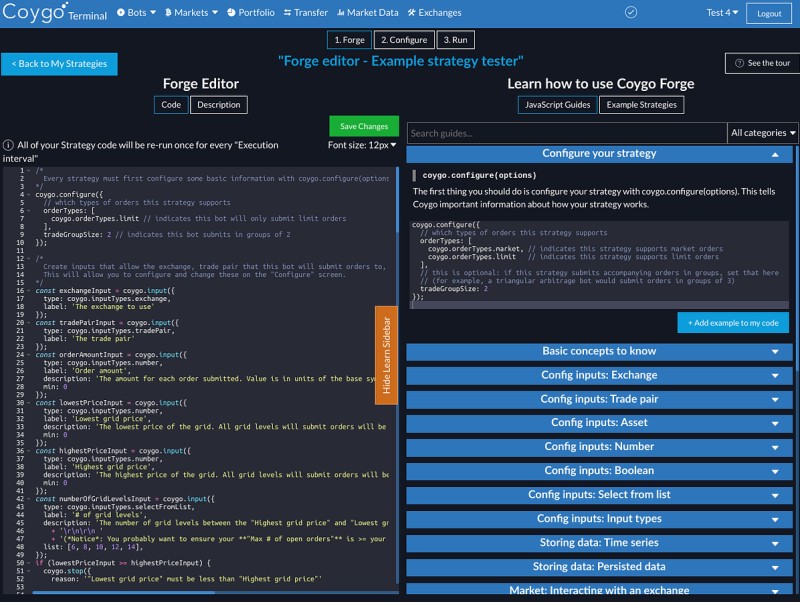
Some coders build their own. A basic Python script can pull Kraken data, make a dataframe, and use moving averages to fake trades. That is algorithmic trading cryptocurrency in its raw form.
Settings That Make or Break Your Bot
Bot results depend on settings, not just the brand. The main knobs are price range, investment, order size, step, stop loss, take profit, demo, and backtest.
Price range sets where the bot is active. For grid bots this is key. Too narrow and it stops early. Too wide and your cash is spread too thin. Use recent support and resistance to pick it.
What each setting controls
- Price range - where the bot trades, defines active zone.
- Investment amount - how much capital the bot uses.
- Order size - how much each trade uses, affects risk.
- Grid step or DCA step - distance between orders.
- Stop loss - when bot exits at a loss to limit downside.
- Take profit - when bot locks profit by plan.
- Demo mode - test behavior with no real funds.
- Backtesting - check past behavior to validate assumptions.
Bad settings can ruin a good bot.
Hey, don't skip this part. Use demo mode before real money. Backtest does not predict the future but shows if the plan is sane. Match bot type to strategy or you will fight it.
Easy Path for Beginners
If you are starting crypto trading, you do not need to code. Many platforms give visual setup. You pick bot type, use quick setup, tune range and risk, then run demo first.
I would point new folks to automated trading bots for beginners that have a clean UI and a community. A good trading bot app should show backtest and let you launch small.
automated trading bots for beginners trading bot appBefore launch, check the market view is clear, range is based on chart, size is controlled, stop is set, take profit is planned, demo was reviewed, and backtest was checked. That five minute check saves pain.
AI Bots and the Best Apps
AI auto trading bots read massive data and shift with market state. Some use machine learning and NLP to read mood from news and social posts. They adapt instead of just repeating old code.
If you want the best ai crypto trading app, look for one with backtest, multi-exchange, and clear risk tools. The best ai for crypto trading is not the one with the loudest claim, it is the one that fits your goal.
ai auto trading bots best ai crypto trading app best ai for crypto tradingOne developer ran a bot with technical plus sentiment weight 60/40. Between two past months in 2020 it showed a 61.5% success rate and strong cumulative result. That is real but not a promise for you.
Arbitrage Across Exchanges
Arbitrage is simple to say. If BTC is $93,000 on one exchange and $93,200 on another, buy low sell high at once. The gap is your profit. Bots catch these fast, people mostly miss them.
The best crypto arbitrage platforms support many exchanges and low latency. They grab most chances under three seconds. Average profit per trade is small, like 0.2-2%, but it adds up with volume.
best crypto arbitrage platformsLiquidity is split across venues, so the best deal is not always on one. A bot that watches 50+ exchanges at once has an edge a single screen cannot give.
Building Your Own Bot from Code
You can build a bot if you code a bit. A hobbyist used Python and Kraken API. The plan was SMA crossover: buy when short average goes above long, sell when it drops below.
On BTC the simple test lost about 6.6%. On a stock it gained about 39.5%. EMA and MACD gave similar gaps. Crypto was wilder, moved by tweets and 24/7 noise. That shows why testing matters.
Algorithms work better on traditional stocks: crypto more volatile, influenced by tweets, 10-20% moves in hours.
Another coder started in 2017 with MACD then added capital rules and sentiment. He pulled order book and candles by websocket for many BTC pairs. The system used Node.js, TensorFlow, and a DB with millions of rows per day.

Reinforcement learning bots train on quote data from years like 2019 through 2024. They learn by trial and error on calm, euphoric, and crash periods. That helps them not freak out live.
Risks and Pitfalls to Respect
Bots fail for dumb reasons. Over-tuning to past data makes it look great then flop live. Ignoring fees is a big one. Exchange fees, spread, and slippage eat small edges fast.
Other traps: no risk limit, quitting during a drawdown, and never checking the bot. AvaTrade notes tech bugs, connect drops, and flash crashes. Washington Beer Blog warns on API access and complexity.
Common mistakes from Bitsgap list
- Choosing range without checking the chart.
- Using too much capital in one setup.
- Ignoring stop loss completely.
- Copying another trader's settings blind.
- Launching without demo or backtest.
- Changing settings too often.
- Picking bot before the strategy.
Algorithm failures - poorly built bots misread market, execute late, amplify losses.
Best practice is simple: check performance every few hours, set max loss per trade at 1-2% of capital, and keep a human in the loop for big moves. Emergency stop at 7% drawdown is wise.
Choosing the Right Trading Bot
Pick by execution, not hype. Check supported order types, position logic, and alert flexibility. The bot should size right and handle multiple strategies on one asset if you need that.
Exchange cover matters. It should reach Binance, Bybit, Kraken, OKX, KuCoin, and some DEX. Asset class flexibility like spot, futures, even stocks helps if you grow.
What to verify before you pay
- Published uptime 99.9%+ with redundant infrastructure.
- Execution speed benchmark from alert to placement.
- API key with restricted access and good reputation.
- Backtesting and analytics dashboard included.
- Ease of use and support for beginners.
- Clear pricing with subscription and exchange fees shown.
Trading bots are not one-size. Some grow capital in up markets. Some just cut loss in down ones. Fit to your goal beats a big return claim on a sales page.
Roadmap to Automated Trading
You don't need to go all in day one. Phase one is strategy validation in a tool like TradingView. Backtest many conditions and find weak spots.
Phase two is paper trading. Connect the bot in paper mode and watch alerts and fills. Phase three is small live, like 10-20% size. Phase four is full size with steady checks.
Four phases
- Weeks 1-4: build and backtest strategy.
- Weeks 5-8: paper trade and verify tracking.
- Weeks 9-12: limited live with small size.
- Week 13+: full deploy per risk rules.
The right platform gets invisible. You focus on the plan while it sends orders right. That is the point of a trading bot crypto, less hand work, more rule follow.
Advanced Plays and What Is Next
Pros use tricks hard to do by hand. Multi-timeframe confirm only takes a long when bigger chart is bullish. Correlation pair trades mean revert when ETH/BTC drifts.
Volatility sizing shifts trade size by ATR or Bollinger width. Multi-strategy portfolios run trend, mean revert, and breakout at once. News and time-of-day tweaks flatten before big prints.
Custom strategies with professional execution represent sustainable path versus pre-built or copy trading.
Future bots will use on-chain metrics, social mood, funding rates, and cross-chain DeFi. Machine learning will pair with human risk control. That is where algorithmic trading cryptocurrency is headed.
My Plain Take on Bot Use
I like that a trading bot crypto removes the sleep problem. The market never closes and a bot does not need coffee. But the settings are yours, so learn them before money goes in.
If you are starting crypto trading, begin with demo and a small plan. Use automated trading bots for beginners only after you understand range and stop. Copy trade cryptocurrency if you must, but know the risk is someone else's.
starting crypto trading trading botsAt the end of the day the bot is a tool. A good one with bad rules loses. A plain one with clear rules and risk limit can beat just holding. That is the real edge.



Comments on “How a Trading Bot Crypto Works and How to Set It Up”
No comments yet. Be the first to share your thoughts.