

How Does a Crypto Miner Work
I get asked what is mining for crypto a lot. The short answer: a miner is a computer that solves hard math puzzles to confirm transactions on a blockchain. When it solves one, it adds a block of data and earns a reward. That is the whole idea. The rest is just details - power, cooling, hardware, pools, and the economics that make it worth it or not.
Think of a what is mining crypto coins machine as a very fast guesser. It takes a block of transactions, adds a random number called a nonce, runs the whole thing through SHA-256, and checks if the hash is below the network target. If not, it changes the nonce and tries again. Millions of times per second. The first one to hit a valid hash broadcasts the block, everyone verifies it, and the chain grows by one.
The Role of a Miner in Proof of Work
A miner can mean the person, the machine, or the software. The machine does the hashing. The software connects to peers or a pool, builds candidate blocks, submits shares, and collects rewards when the pool finds a block. In Proof of Work, consensus comes from computational effort. You prove you burned energy by finding a hash below the target. That is your vote. No central authority needed.
Mining is therefore both a validation process and a competition to produce the accepted version of the shared ledger.
The miner checks each transaction: signatures are valid, inputs exist and are unspent, outputs don't create new coins except the coinbase. Then it packs them into a candidate block, does the work, and hopes to win. If two miners win at almost the same time, the network temporarily forks. The chain with more accumulated work wins. The other branch gets abandoned, and its transactions go back to the pending queue.
Transaction and Block Processing Step by Step
Here is the basic flow, stripped down:
Basic Mining Sequence
- A wallet creates a transaction with inputs, outputs, and a signature.
- The transaction is broadcast and lands in the pending queue.
- Miners pick transactions and build candidate blocks.
- Each miner hashes the block header with different nonces.
- The first valid hash wins. The block is broadcast.
- Other nodes verify the proof and the transactions.
- The block is added. The miner gets the subsidy plus fees.
- Later blocks stack on top, adding confirmations.
- If competing blocks appear, the chain with most work wins.
The work is not a normal equation with a useful answer. It is a brute-force search. A tiny change in the nonce produces a completely different hash. You just keep trying until you get lucky. The network adjusts the target so a block appears roughly every 10 minutes on average. Sometimes it takes 1 minute, sometimes 20. The interval is an average, not a schedule.
UTXOs, Scripts, and How Transactions Actually Work
Bitcoin does not track coins as objects. It tracks Unspent Transaction Outputs, or UTXOs. A transaction consumes one or more UTXOs entirely and creates new ones. If you have a 0.2 BTC output and want to send 0.15 BTC, you create two outputs: 0.15 BTC to the recipient, 0.05 BTC back to yourself as change. The difference between total inputs and total outputs is the fee.
Each output has a locking script that sets the spending condition. The most common is Pay-to-Public-Key-Hash: the output locks funds to a hash of the public key. To spend, you provide the full public key and a signature in the unlocking script. The script checks the hash matches, then verifies the signature. This is how ownership works without a central database.
A transaction cannot partially spend only part of one UTXO. To send only part of a larger output, the transaction divides that value among several new outputs.
Private Keys, Public Keys, and Addresses
Everything starts with a private key - a random 256-bit number. The public key is derived by multiplying the secp256k1 generator point by that secret. The address is not the public key directly. It is the public key hashed with SHA-256, then RIPEMD-160, with a version byte and checksum, encoded in Base58Check. The result looks like 1A1zP1eP5QGefi2DMPTfTL5SLmv7DivfNa. You can share the address freely. The private key never leaves your wallet.
When you sign a transaction, you sign a modified version where the input's script is replaced with the output's locking script. This lets each input owner sign independently. The signature uses ECDSA with a random nonce. Reusing that nonce across different messages leaks the private key. Production code uses deterministic nonce generation like RFC 6979.
SHA-256, Nonces, and the Target
SHA-256 takes any input and produces a 32-byte digest. Change one bit, the output changes completely. You cannot reverse it. You cannot find a collision easily. Mining is: given a block header, find a nonce so that SHA-256(SHA-256(header)) is below the target. The target is a 256-bit number derived from difficulty. Lower target means harder.
A simplified example: find a hash starting with four hex zeroes. how do blockchains work at this level - they just keep hashing until the digest is small enough. The probability of any single try succeeding is about 1 in 16^n for n leading zeroes. For four zeroes, that is 1 in 65,536. Bitcoin's real target is much smaller. ASICs do this search with specialized hardware, billions of hashes per second.
Hash Rate and Your Chance to Win
Hash rate is how many hashes your machine does per second. Units go from H/s to PH/s. Your chance to find the next block is roughly your hash rate divided by total network hash rate. At 1% of network power, you have about 1% chance per block. A 2020 snapshot put total Bitcoin hash rate around 120 million TH/s. A typical ASIC at 50 TH/s had a 0.00004% chance per 10-minute window. Those numbers are old, but the relationship holds: more hash rate share means more blocks over time.
You do not prove work per transaction. You prove work per block header. Other nodes still check every transaction inside. The block header includes the previous block's hash, linking the chain. Change an old transaction, its hash changes, the next block's link breaks, and the whole chain after it becomes invalid. That is how the ledger resists tampering.
Confirmations and Double-Spend Resistance
A transaction in a block has one confirmation. Each new block on top adds another. Six confirmations - roughly an hour at 10-minute blocks - used to be the standard for "final." The deeper the block, the more work an attacker needs to rewrite history. To double-spend, you would need to build a competing chain with more accumulated work than the honest chain. That means controlling more than half the total hash rate. With less than half, you might get lucky for a block or two, but sustaining a lead is statistically near impossible.
An attacker who creates a conflicting branch needs enough computational power to catch up with or overtake the rest of the network.
Block Rewards, Halving, and Fees
The miner of an accepted block gets the coinbase transaction: the block subsidy plus all transaction fees in that block. The subsidy started at 50 BTC and halves every 210,000 blocks - roughly every four years. It went 50 → 25 (2012) → 12.5 (2016) → 6.25 (2020) → 3.125 (2024). The schedule is enforced by consensus rules. Nodes reject blocks with the wrong subsidy. Around 2140, the subsidy drops below one satoshi and effectively hits zero. After that, only fees pay miners.
Why Fees Matter
- Blocks have finite space.
- Miners prioritize higher-fee transactions.
- Fees incentivize including smaller or lower-fee transactions.
- After subsidy ends, fees must support block production.
A higher fee makes inclusion more likely, but does not guarantee instant confirmation. Miners choose which pending transactions go into their candidate blocks.
Proof of Work vs Proof of Stake
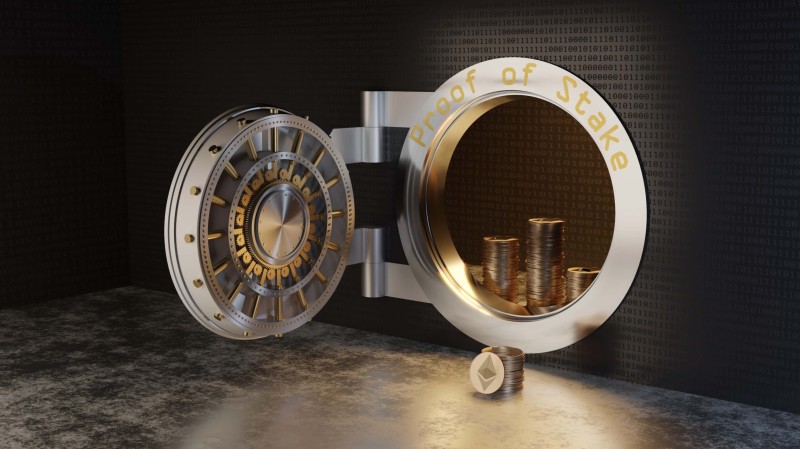
Proof of Stake replaces hashing with locked collateral. Validators stake tokens and are selected to propose or validate blocks. Dishonest behavior gets slashed. Ethereum switched in September 2022. Peercoin was the first in 2013. Staking uses far less energy. You can run a validator (32 ETH for Ethereum) or delegate to one. Rewards come from issuance and fees. But staking has its own risks: locked liquidity, slashing, validator dependence, exchange custody risk, smart contract risk in liquid staking.
what is a blockchain technology question often comes down to this choice: burn energy for consensus, or lock capital. Both have trade-offs. Bitcoin stays Proof of Work. Ethereum moved on. Other chains pick one or the other.
Hardware Evolution: CPU to GPU to ASIC
Early Bitcoin mining ran on CPUs. Then GPUs took over - parallel hashing was faster. Then ASICs arrived, built for one algorithm only. Bitcoin ASICs do SHA-256. Litecoin ASICs do Scrypt. Ethereum used DaggerHashimoto (GPU-friendly) before the Merge. Monero uses RandomX (CPU/GPU). Grin and Raven used GPU algorithms. An ASIC for one algorithm cannot mine another. When difficulty rises or a better chip ships, older machines become obsolete.
A 2025 home-mining guide listed three compact ASICs:
Example Home ASICs (2025 Snapshot)
- Iceriver AE1 Lite - zkSNARK, 300 MH/s, 500 W, 45 dB, for Aleo
- Goldshell E-AE1M - zkSNARK, 230 MH/s, 2000 W, 50 dB, for Aleo
- Canaan Avalon Q - SHA-256, 90 TH/s, 1674 W, 45 dB, for Bitcoin
These are snapshots. Performance, availability, difficulty, and profitability change. Efficiency (watts per hash) matters more than purchase price because electricity is a recurring cost.
Mining Pools and Cloud Mining
Solo mining against the whole network is a lottery. Most small miners join a pool. The pool combines everyone's hash rate, acts like one big miner, and splits rewards by contributed shares. You get smaller, regular payouts instead of rare big ones. Pool considerations: fee, minimum payout, payment schedule, uptime, hash-rate reporting, geographic distribution, support, server upgrades, coin/algorithm support.
Cloud mining rents hash power from a provider. No hardware, no cooling, no noise. But contracts can be opaque with hidden costs. You depend on the provider's uptime, withdrawal terms, and solvency. The underlying facility still faces electricity, hardware, and market risks.
Home Mining: Physical Setup
Home mining is possible with efficient, quiet ASICs. But you need:
Home Mining Requirements
- Power - check circuit capacity. A 1200 W load fits many household circuits; bigger units need dedicated circuits. Avoid undersized extension cords.
- Cooling - ASICs turn most electricity into heat. Move air across the machine, exhaust heat from the room. Warm climates may need AC or heat exchange.
- Noise - single units run 45–55 dB. Multiple units add up. Basement, garage, or isolated room helps. 55 dB is a good target for living spaces.
- Internet - stable connection to pool or peers. Wired Ethernet preferred. Wi-Fi works but drops hurt uptime. Data usage is low, under 50 MB/day.
- Safety - keep away from flammables. Check cables. Power down before maintenance. Clearance around fans and PSUs.
The Economics: Revenue, Costs, and Risk
Mining is a business. Revenue depends on coin price, your hash rate, network hash rate, block reward, fees, pool fees, uptime. Costs: electricity, cooling, hardware, maintenance, connectivity, pool fees, taxes, opportunity cost of capital. The rough cost per coin:
Mining cost per coin = (electricity cost + hardware cost + cooling and operating cost) / accepted or expected coin output
Example: a 600 W rig running 24/7 uses ~14.4 kWh/day. At $0.10/kWh, that is $1.44/day or ~$43/month for electricity alone. Add cooling, hardware depreciation, pool fees, taxes. The block reward is not guaranteed income - only the winning block pays. Your expected reward tracks your share of network hash rate.
Difficulty rises as more hash rate joins. Your fixed machine produces the same hashes, but its share of the network shrinks. Revenue drops even if electricity and hardware stay the same. Halving cuts the subsidy in half. To stay profitable, you need price to rise, efficiency to improve, costs to fall, or hash rate share to grow. Volatility makes short-term revenue unpredictable.
Difficulty Adjustment and Competition
The network retargets difficulty every 2016 blocks - roughly two weeks at 10-minute blocks. More hash rate → higher difficulty → same block interval. Less hash rate → lower difficulty. The adjustment is not instant. A miner's earnings depend on: hash rate, power consumption, electricity price, cooling cost, network difficulty, coin price, block reward, pool fee, hardware cost, machine efficiency. Mining calculators combine these variables.
Energy Consumption and Criticism
Proof of Work burns electricity by design. The machine hashes, cooling moves heat, power infrastructure loses some in conversion. Large operations create substantial local load. Estimates have compared Bitcoin's draw to small countries. Ethereum faced similar criticism before the Merge. Bitcoin remains a target for carbon and fossil-fuel critiques. The argument that its narrower use case (payments) draws less fire than Ethereum's broader dApp ecosystem does not remove the scrutiny.
Legal and Tax Considerations
Regulation varies. China banned mining in 2021. Israel treats it as a business subject to corporate tax. India has uncertainty. The US and Canada were relatively friendly at last check. FinCEN may classify miners as money transmitters. Home miners must check local rules on registration, energy use, tax reporting, business licensing, emissions, equipment imports, and utility restrictions. A machine being technically capable does not make it legal to operate.
Tax hits in two stages: when you receive the reward (ordinary income at fair market value), and when you sell or dispose (capital gain or loss). The IRS Notice 2014-21 covers the first. Treatment differs by status: trade/business, independent contractor, employee, investor. Rules vary by jurisdiction.
Security Assumptions and Open Questions
The informal security model assumes honest miners control majority hash rate. If one entity gets >50%, it can influence ordering, delay transactions, or block other branches. Concentration in a few large pools raises this risk. The 2013 protocol notes listed open issues: nonce-search patterns, candidate block differences, pool work assignment, denial-of-service vectors, fee market evolution, scalability, and decentralization pressure. The original Bitcoin paper did not include a rigorous security proof. Research continues.
From Raw Transactions to the Accepted Ledger
The whole system is a graph of UTXOs. Wallets sign transactions referencing previous outputs. Nodes relay pending transactions. Miners select, order, and hash. The network verifies the winner. The accepted block extends the chain with a coinbase. Later blocks add depth. The UTXO set updates as outputs are spent and created. Miners get subsidy and fees. No single company maintains the database. Every participant can verify the rules independently. Incentives align to keep the chain growing.
If you are looking at bit coin mining rigs or wondering about best cryptocurrency for mining , start with the economics. Calculate your all-in cost per coin. Compare to market price. Factor in difficulty trajectory, halving schedule, and your electricity rate. helium mining and other niche algorithms have different hardware and economics. new cryptocurrency news often hypes coins that fade fast. Stick to chains with durable hash rate and clear consensus rules.
what are crypto currencies at core? They are distributed ledgers with a consensus mechanism. block chain what is it - a chain of blocks linked by hashes, each committing to the history before it. Mining is just the Proof of Work way to decide who writes the next page. Understand the primitives - UTXOs, scripts, hashes, difficulty - and the rest follows.













Comments on “How Does a Crypto Miner Actually Work? Clear Steps to Understand the Process”
No comments yet. Be the first to share your thoughts.