Centralized and Decentralized Exchanges
When you start looking at a top cryptocurrency exchange , the first thing to understand is the model. Centralized exchanges, or CEXs, work like traditional financial companies. A single entity runs the order book, holds your funds, and handles compliance. Decentralized exchanges, or DEXs, run on blockchain networks without a middleman. You keep control of your keys. Both models exist for a reason, and the choice shapes everything from sign-up to security.
A CEX has to coordinate a lot of moving parts: order matching, custody, identity checks, liquidity, regulatory reporting, and system monitoring. Security controls run through onboarding, trading, and off-boarding. A DEX skips most of that infrastructure but puts the burden on you. Neither is perfect. The trade-off is control versus convenience.
How Identity Verification Works Across Major Exchanges
Sign-up used to be fast and loose. Now every major platform requires some form of KYC. The general pattern starts with electronic identity verification - you enter basic info like name, address, and date of birth. Higher limits or fiat access usually trigger document checks: passport, driver's license, proof of address, sometimes a selfie or Social Security number. The exact flow depends on the exchange, your country, and what you're trying to do.
Some platforms let you trade crypto with minimal verification but lock fiat deposits and withdrawals behind full KYC. Others tier limits by account age, purchase history, payment method, and intended use. There's no universal standard. That's why comparing exchanges means looking past the homepage and into the verification tiers.
Identity verification is necessary for Know Your Customer compliance, but poorly automated procedures can make sign-up difficult and delay account processing.
Coinbase Verification and Limits
Coinbase launched in 2012 and went public in 2021. At the time of the source overview, it reported over 56 million users. The platform uses a mix of factors to set limits: verification types added, account age, purchase history, and payment method. Verification steps include phone number, personal details, photo ID, and a Social Security number for U.S. users. The source doesn't publish a current tier schedule, so you'll need to check the site for today's limits.
Coinbase Pro exists for more active traders, but the core platform positions itself as a wallet and on-ramp first. If you're in the U.S. and want a straightforward start, it's often the first name people mention. But that convenience comes with strict KYC from day one.
Kraken Account Tiers
Kraken started in 2011 and offers more than 50 tokens plus multiple fiat currencies - USD, EUR, GBP, CAD, JPY. It uses four account tiers: Starter, Express, Intermediate, and Pro. Your intended use determines the tier. Higher tiers unlock more funding options and larger limits. All accounts need email, full name, date of birth, phone, and physical address. Starter skips employment and SSN. Intermediate and Pro add valid ID, proof of residence, and a face photo for certain countries. Pro also requires a KYC questionnaire.
Geographic restrictions apply based on account type and service level. You must be 18 or older. The source presents this in its 2021 context, so current rules may differ.
Kraken verification basics by tier
- Starter: email, name, DOB, phone, address - no SSN or employment info
- Express: adds employment and SSN for U.S. customers
- Intermediate: adds valid ID, proof of residence, face photo for some regions
- Pro: all of the above plus KYC questionnaire
Binance Verification Levels
Binance uses three levels: Basic, Intermediate, and Advanced. Basic asks for name, address, date of birth, and nationality - lifetime limit of $300. Intermediate requires an uploaded government ID (passport, ID card, driver's license). Advanced adds proof of address like a bank statement or utility bill. The source doesn't list limits for Intermediate and Advanced. Binance is often cited as the largest by trading volume, but the verification climb is steeper if you want real capacity.
If you only need small amounts, Basic might work. For anything serious, expect to upload documents. The tier structure is simple but the $300 lifetime cap on Basic is a hard wall.
Bitfinex and OKEx Verification
Bitfinex, founded in 2012, splits accounts into Basic, Basic Plus, Intermediate, and Full. A Basic account only needs an email - you can deposit, trade, and withdraw crypto immediately. Fiat requires verification, which can take two to three days. All users need phone, email, and residential address. Higher tiers add two government photo IDs, proof of address, and for Full, a financial statement.
OKEx, founded in 2014, took a different approach. No identity verification needed for crypto-only deposits and trades. Verification kicks in for fiat purchases (sometimes via third party) and daily withdrawals over 10 BTC. Three levels: Basic ID (nationality, name, document number), Photo ID (document plus facial verification), and a disclaimer read in the app. The 10 BTC threshold and procedures reflect the source's 2021 context.
A Basic account could be used for immediate crypto deposits, trading, and withdrawals, while fiat activity required verification.
KYC Requirements and Where Regulation Is Heading
All five exchanges in the overview required some form of identification. The progression moves from basic electronic data to document checks for higher-value accounts. As more users and money entered crypto, regulators started defining stricter KYC rules. Some examined whether travel-rule requirements should extend to crypto wallets.
The source doubts new standards will weaken KYC. Clearer rules could give exchanges continuity across jurisdictions. Exchanges need identity processes that are thorough, secure, compliant, quick for users, and seamless for staff. Automated verification helps speed onboarding without sacrificing compliance. Manual or broken document checks drive abandonment and lost revenue.
Security, Reserves, and Custody Basics
A CEX holds your assets. That custody role makes security central to any comparison. You should know what identity data is collected, why each document is requested, which actions are available before full verification, how fiat and crypto transactions differ, what custody arrangement applies, whether reserves are independently examined, what controls protect accounts, and how to move assets to self-custody.
The source mentions a July 2026 listing where MEXC claimed a 281% Bitcoin reserve ratio and CoinGecko ranked it high in perpetual futures volume. These are published claims. A comparison should distinguish an exchange's own reserve statement from an independent audit - they're not the same evidence. The same goes for gaming transparency models like Maczo's provably fair verifiers. Different domains, same principle: verify, don't just trust.
Comparing Product Scope Across Exchanges
The exchange profiles show real differences. Coinbase focuses on wallet and platform simplicity with limits tied to verification, age, history, and payment method. Kraken supports 50+ tokens and five fiat currencies with tiers linked to intended activity. Binance's three levels cap Basic at $300 lifetime. Bitfinex offers 38 tokens, margin trading, margin funding, and OTC - Basic works for crypto-only. OKEx covers spot, margin, options, perpetual swaps, DeFi, lending, and mining - no KYC for crypto-only, but verification for fiat and large withdrawals.
A low-friction crypto-only account may still have low limits. A higher tier may unlock larger transactions, fiat funding, or extra services. Don't judge sign-up ease by whether an account can be created. Judge by what you can actually do with it.
Quick product scope comparison
- Coinbase: wallet-first, U.S.-centric, strict KYC from start
- Kraken: 50+ tokens, multi-fiat, four tiers tied to use case
- Binance: three levels, $300 lifetime Basic cap, heavy volume
- Bitfinex: margin, OTC, crypto-only Basic with no verification
- OKEx: broad derivatives, DeFi, mining, KYC only for fiat and large withdrawals
WhiteBIT Product and Payment Updates
WhiteBIT's blog shows a range of features worth comparing: traditional finance products like stocks, Convert promotions, futures tournaments, a Nova card, SWIFT USD transfers announced July 2026, a redesigned VIP program, and educational content on hot wallets, Banking as a Service, and crypto bundles. SWIFT adds a bank-transfer payment method, but the source doesn't give processing times, fees, jurisdictions, or limits.
Educational topics include Bitcoin price history from 2009 to 2026, margin trading, smart contracts, and partnerships. These materials can help you understand product features before opening or funding an account. An exchange that invests in education often signals a longer-term orientation.
How a Centralized Exchange Works Under the Hood
The core is the trade engine - stateless microservices that match orders. When you place an order, the engine processes it and matches buyers and sellers at best prices. Trading info lives in trade feeds and order books. Blockchain nodes and wallets settle and store assets as custodians. Modern engines blend blockchain tech with order processing for speed and security.
Order books hold all open bids and asks with prices and quantities. Trade feeds record completed transactions: execution price, volume, timestamp, side. Together they support price discovery, history, analysis, and user records. Real-time market data from external providers keeps transactions at market rates. Analytics detect unusual patterns, support business analysis, produce regulatory reports, and improve the trading experience. Professional liquidity providers and market makers keep trading pairs healthy and markets orderly.
Security applies throughout the exchange lifecycle: onboarding, trading, off-boarding. User-asset protection is described as a requirement across all trading stages.
AWS Reference Architecture for a CEX
A reference architecture on AWS splits the platform into four modules: user interface, API layer and core services, blockchain layer, and wallet layer. The UI uses Amplify, Route 53, CloudFront, WebSocket connections via Network Load Balancer, and EC2 Auto Scaling for demand spikes. Core trading runs on Fargate with ECS or EKS. Blockchain nodes run on EC2 with x86 or Graviton processors. Wallet security uses KMS for key protection and Nitro Enclaves for sensitive ops.
Storage is split by data type: Aurora or RDS for trading records, ElastiCache for pricing, DynamoDB for user info, OpenSearch for advanced search, S3 for files. Real-time streams use Kinesis, MSK, and EventBridge with filters, access controls, and data protection. External connections use Transit Gateway, NAT gateways, Site-to-Site VPN, and Direct Connect. Analytics layer uses S3, Glue, Lake Formation, Redshift, Athena, QuickSight, SageMaker, Bedrock, and Lambda. Security monitoring uses CloudWatch, X-Ray, IAM, Shield, CloudTrail, GuardDuty, WAF, and Security Hub.
This technical depth matters because payment availability, partner connectivity, and private network access affect funding and trading reliability. The architecture also shows the gap between a front-end sign-up flow and the systems protecting accounts, wallets, and infrastructure.
Tether USDT and Stablecoin Counterparty Risk
USDT, introduced in 2014 by Tether Limited (owned by iFinex, which also runs Bitfinex), is a dollar-pegged stablecoin. It had the highest trading volume of any cryptocurrency and 70% of the stablecoin market per a 2025 article. It surpassed Bitcoin as the most traded asset in 2019. Tether claims every token is backed by equivalent USD reserves, but it has never undergone a full independent audit. USDT has occasionally traded below its peg.
This makes reserve composition, audit status, redemption terms, and counterparty exposure relevant when comparing exchanges that offer USDT pairs. Holding a dollar-pegged token reduces crypto-price volatility but doesn't remove issuer, reserve, counterparty, liquidity, or exchange risk. USDT runs on Ethereum, Tron, Solana, and other chains - no native blockchain. Moving between chains requires bridging. It's used in DeFi on Aave, Uniswap, Compound for lending, collateral, and liquidity pools.
USDT basics to remember
- Pegged to USD, not government-issued dollars
- No full independent audit completed per source
- Runs on multiple blockchains, not its own
- Used across DeFi for lending, collateral, liquidity
- Counterparty risk stays with issuer and exchange holding it
ISO 20022 and What It Means for Crypto
ISO 20022 is a financial-messaging standard to unify bank payment formats into a common XML language. Crypto projects don't get official ISO certification. When a project says "ISO 20022 compliant," it means it supports messaging formats consistent with the standard. The standard covers business models, process descriptions, message formats, and documentation maintenance. SWIFT registers and maintains it. Initial version came in 2008.
Potential benefits: faster payments, lower costs, easier compliance, less fraud, fewer errors, better interoperability, improved cross-border efficiency, clearer institutional clarity. The source lists nine assets with ISO 20022 alignment claims: XRP, XLM, XDC, ALGO, IOTA, HBAR, QNT, ADA, and XVG (the intro says eight, body covers nine). Ripple and Stellar are members of the ISO 20022 Standards Body. Bitcoin doesn't directly align - it wasn't designed for financial messaging.
HSBC, Deutsche Bank, and JPMorgan are transitioning to ISO 20022. Implementation spans the U.S., UK, EU, Australia, Japan. Digital Token Identifiers (DTI) could authenticate crypto transfers using ISO 20022 standards. The source notes investment decisions need research and risk consideration.
Geographic Availability and Adoption Data
Identity requirements and services vary by jurisdiction. Kraken applies geographic restrictions by account type and service. OKEx served 100+ countries. Coinbase requires a U.S. Social Security number. Country of residence, supported fiat, and regulatory jurisdiction all matter for comparison.
The Chainalysis 2025 Global Crypto Adoption Index ranks 151 countries using four sub-indices weighted by purchasing-power-adjusted GDP per capita. India ranked first overall and in all four components. U.S. second. Pakistan, Vietnam, Brazil round out the top five. Asia-Pacific leads grassroots activity. Population-adjusted rankings flip the list: Ukraine, Moldova, Georgia lead per capita. High per-capita adoption associates with economic uncertainty, distrust in traditional finance, and technical literacy.
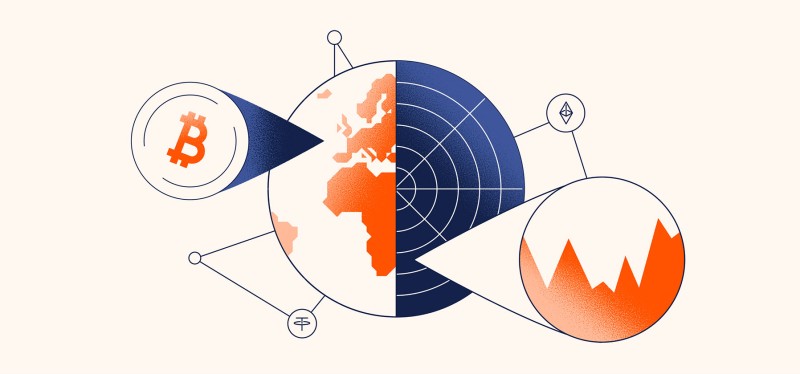
A smaller country can have high per-capita adoption even if its absolute transaction volume is lower than that of a larger market.
Stablecoin Volume and Payment Trends
Regulatory changes in the U.S. (GENIUS Act) and EU (MiCA) created paths for licensed stablecoins like EURC. But on-chain volume stays dominated by USDT and USDC. USDT routinely processes around $703 billion monthly, peaking at $1.01 trillion. USDC ranges from $3.21 billion to $1.54 trillion monthly. Smaller stablecoins grow faster: EURC up nearly 76% month-over-month on average, PYUSD from $785M to $4.8B.
Traditional companies are entering: Stripe, Mastercard, Visa for stablecoin spending rails. MetaMask, Kraken, Crypto.com for card-linked payments. Circle, Paxos, Nuvei for settlement partnerships. Citi and Bank of America exploring their own stablecoins. USDC growth ties to U.S. institutional rails. EURC to MiCA-compliant platforms. PYUSD to retail and payment demand for regulated alternatives. Stablecoin availability on an exchange is only one piece - network support, card access, merchant settlement, regulation, and institutional corridors shape actual use.
Fiat On-Ramp Patterns
Chainalysis examined centralized-exchange fiat purchases from July 2024 to June 2025. Bitcoin led with over $1.2 trillion in fiat inflows. Ethereum got about $724 billion. Other layer-1s (excluding Solana) $564 billion. Stablecoins $497 billion. Everything else under $200 billion. Bitcoin's fiat inflow was slightly more than 70% higher than Ethereum's.
By geography: USD led with over $2.4 trillion. South Korea followed at $722 billion. EU just under $250 billion. Bitcoin represented roughly 41% of U.S. fiat purchases, 34% UK, 27% EU. South Korea and Turkey showed more diversified on-ramp profiles. The analysis covers only tracked centralized exchanges - not OTC desks, informal systems like hawalas, or cash-based crypto shops, which may matter in some regions.
Adoption by Income Group
High-income, upper-middle, and lower-middle-income countries hit similar adoption peaks - broad-based, not limited to one economic tier. Emerging-market adoption connects to remittances, stablecoin dollar access, and mobile-first financial services. Low-income countries show volatile, episodic activity driven by policy shocks, connectivity limits, liquidity problems, and conflict. Afghanistan temporarily lost all measured activity after the 2021 U.S. withdrawal. Durable adoption in low-income regions needs better on-ramps, regulatory clarity, basic financial infrastructure, and digital infrastructure.
Finding Reliable Crypto Information
A fast-changing market creates a role for blogs that explain news, tech, security, and risk. Good articles translate blockchain developments, exchange updates, investment risks, and asset mechanics into clearer explanations. Comparing sources reduces dependence on social-media rumors and exposes gaps between official info and promotional claims.
Crypto blogs cover project launches, exchange updates, price events, tech upgrades, DeFi explanations, trading analysis, wallet comparisons, security guidance, market analysis, Web3 education, and real-world applications. Prices react to regulations, hacks, launches, security upgrades, privacy changes, partnerships, new products, payment tools, and blockchain upgrades. Regular reporting gives context for market moves and helps identify changes affecting exchange availability, supported assets, withdrawal rules, or counterparty risk.
Types of cryptocurrency blogs to follow
- News blogs covering projects, blockchain, market trends
- Trading blogs covering methods, analysis, advanced techniques
- Educational blogs explaining how crypto works
- Community blogs with interviews, opinions, personal experiences
- Project-update blogs tracking exchanges, security, privacy, payment tools
A transparent blog should explain risks, avoid unrealistic profit claims, encourage independent research, cite verified data, and use clear explanations with charts and step-by-step material where appropriate.
Criteria for Choosing a Reliable Crypto Information Source
Look for author credibility - verified experts or known traders. Check content freshness - regular updates. Consider reader reviews and reputation. Favor clarity - explanations that make hard subjects understandable. Verify trusted sources - claims should link to official info. Depth matters - detailed guides build knowledge progressively. Balance is key - reliable sources present positive developments alongside uncertainty and risk.
These criteria apply to exchange-owned blogs too. An exchange blog may give useful product details, but first-party claims should be distinguished from independent security assessments, audited financial data, and regulatory records. Ways to stay current: site or app alerts, official social media, forums, newsletters, comparing several blogs, tracking exchange security upgrades, following business payment tools, monitoring trad-fi/DeFi financial products. Reading more than one source broadens perspective because analysts interpret the same event differently.
Starting to Trade - Basic Risk Controls
The source lists several controls for new traders: learn blockchain and crypto basics first. Follow market news. Start with minimal capital. Use trusted exchange websites. Learn to recognize scams and warning signs. Watch exchange security upgrades and user-protection features. Learn to read price charts. Understand how wallets work. Understand how blockchain transactions are verified. Market volatility, regulatory changes, and tech updates alter prices and exchange conditions fast. Combine current info with independent research and responsible risk management.
When you're evaluating a best crypto exchanges for us residents, or checking fee structures , or comparing a trading platform against another, these basics stay the same. The top rated ones still require you to do your homework. Even a low-fee option can bite you if security or custody is weak.
Key Terms for Exchange Comparison
Understanding the vocabulary helps you compare apples to apples. Blockchain: distributed ledger recording and securing transactions. Wallet: app or device to store, send, receive crypto - exchange-hosted vs self-custody differs in who controls keys. Altcoins: everything besides Bitcoin. Token: digital asset on a blockchain representing utility, asset, stable value, or other function. Market cap: total value of circulating supply. Bull/bear market: prices generally rising or falling. Whitepaper: technical doc explaining a project's tech, goals, roadmap. Gas fees: transaction costs on supported networks. CEX: company-operated, manages transactions, controls assets. DEX: blockchain-based, no intermediary, direct fund control. Custody: arrangement where exchange or third party holds and controls assets. Proof of reserves: exchange claim or assessment about assets held - claims, ratios, and independent audits are different evidence levels. KYC: compliance procedures to establish identity. eIDV: initial identity process with basic info, additional docs for higher limits. Order book: live list of open buy/sell orders with prices and quantities. Trade feed: historical record of completed transactions. Liquidity provider: participant supplying trading pairs and liquidity. Stablecoin: token designed to maintain value relative to a reference asset, usually fiat. ISO 20022: financial-messaging standard for unified electronic payments. DTI: identifier framework for authenticating crypto transfers using ISO 20022-compatible standards. Self-custody: control through user-held keys, not a centralized platform.
Core concepts for exchange evaluation
- Custody model: who holds the keys - exchange or you
- Verification tiers: what each level unlocks and requires
- Fiat access: which currencies, which payment rails, which limits
- Product scope: spot, derivatives, lending, staking, cards, bundles
- Security transparency: reserve proofs, audits, monitoring, insurance
- Geographic eligibility: your country, your fiat, your regulatory regime
- Self-custody path: how to move assets off-platform when needed







Comments on “How to Compare Top Cryptocurrency Exchanges for Security and Sign-Up”
No comments yet. Be the first to share your thoughts.